The Relationship Between Saju and the I Ching
To understand Saju, it helps to begin with the East Asian view of time.
At its foundation is a way of seeing the world not as a collection of fixed things, but as a web of changing relationships. The I Ching, or Book of Changes, is the classic expression of this view.
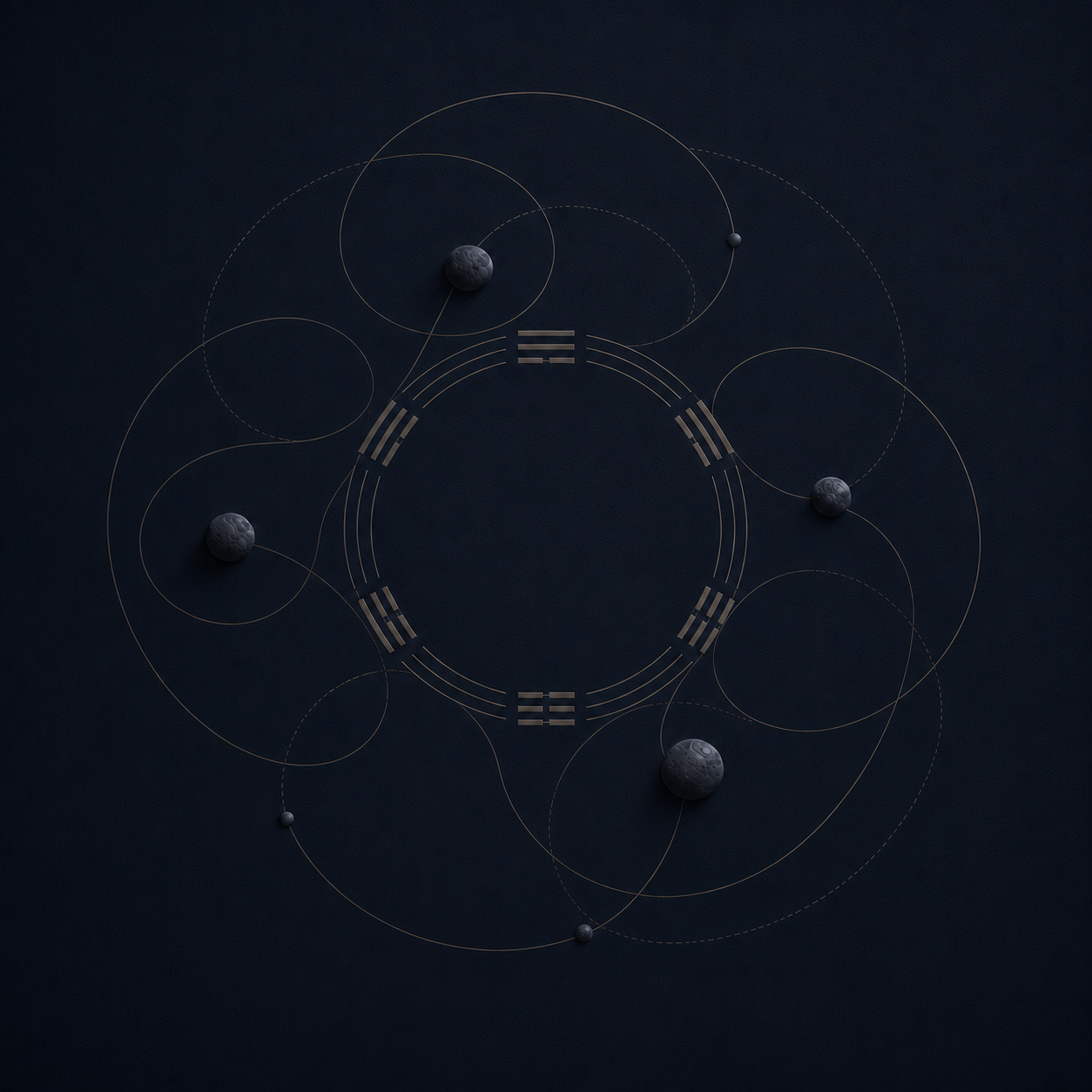
The I Ching took shape in ancient Zhou China as a text about change. Its basic signs are a broken line for yin and an unbroken line for yang. Three lines form one of eight trigrams; two trigrams placed together form the 64 hexagrams, expressing many of the situations and movements that can arise in nature and human life.
The I Ching was not created all at once as a finished work of philosophy. Ancient divinatory statements accumulated commentaries and philosophical reflection over many eras. As a result, it contains both the language of divination, which weighs the promise and danger of a situation, and the language of philosophy, which seeks to understand how change works.
Its central purpose is not to describe future events with precision.
In the world of the I Ching, no condition remains fixed forever. What is strong eventually weakens; what is full begins to decline; what reaches its end becomes the ground for another beginning.
The point is not to label a condition simply good or bad, but to notice where the present situation stands and in which direction it is moving.
Later traditions explained the meaning of yi—change—through three ideas: simplicity, change itself, and constancy.
Simplicity: reading a complex world through elemental principles
Simplicity does not mean that the world is simple or that life is easy.
It means finding the basic structures that recur within complex and varied phenomena. The I Ching begins with only yin and yang, then condenses countless changes in nature and human life into eight trigrams and 64 hexagrams.
Rather than explaining every phenomenon in isolation, it looks for the principles of relationship working through them all.
Light and darkness, movement and stillness, expansion and contraction, disclosure and concealment are not wholly separate. Each gains meaning through its relation to the other, and neither remains in the same place forever.
Simplicity is less an act of reducing the world than a way of finding its most fundamental patterns so that we do not lose our way in its complexity.
Change: everything continues to move
Change means that every being and every situation is continually becoming something else.
Seasons turn, day and night alternate, and human relationships and emotions keep moving. What is strong now will not always be strong; what is lacking now will not always remain lacking.
In the I Ching, a hexagram is less the name of a fixed thing than a scene briefly revealed within the course of a changing situation.
It therefore does not fix a person into a single character or destiny. The same person reveals different aspects depending on their environment, their relationships, and the season of life they are passing through.
Change is not an exceptional event. It is the basic condition of life.
The I Ching asks more than, ‘What will happen next?’
What is changing now? What should be held, and what should be released, within this change? How is the choice made now shaping the current that follows?
These questions lie at the heart of the I Ching.
Constancy: recurring principles within change
If everything changes, the world may seem to sway without any order at all.
Constancy suggests, however, that certain relationships and principles recur through ceaseless change.
No two years have identical seasons, yet spring still turns toward summer. What fills eventually wanes, and a force stretched too far begins to contract. Particular events differ, but recurring structures appear in the way events arise, transform, and pass away. Constancy is the order that continues to operate through the process of change.
It does not mean that a thing or a fate remains unchanged forever.
It means that change itself has a certain order. What endures is not a particular event, but the relational principle by which events transform into and follow one another.
Simplicity, change, and constancy are not three separate theories.
The world changes without pause, yet its changes are not entirely random. Within that complexity, human beings use relatively simple symbols to read recurring structures.
Through these three perspectives, the I Ching sought to understand a changing world.
Everything changes. Yet change has a recurring order. And that order can be read from the simple relationship between yin and yang.
The Relationship Between Saju and the I Ching
The I Ching uses hexagrams to examine a particular situation and the changes possible within it. Saju arranges the year, month, day, and hour of birth as Heavenly Stems and Earthly Branches, then reads the recurring tendencies and structures of life that appear through their relationships.
By using eight characters to find a basic structure within the complexity of one life, Saju resonates with the principle of simplicity.
Saju and the I Ching also share the view that the world is not a collection of fixed objects, but a field of relationships and currents that continually change.
The same birth chart can manifest differently across periods, environments, relationships, and choices. In this sense, Saju carries the perspective of change.
Specific events may differ while similar emotions, ways of relating, and structures of choice recur. This recalls the principle of constancy.
But a recurring pattern is not an unchangeable fate.
When a repetition goes unnoticed, it can continue like destiny. Once it is understood, a different choice becomes possible within it.
Neither the I Ching nor Saju presents a future already complete.
They offer a symbolic map that helps us see what repeats within a changing life, and how the person we are now is relating to that flow.