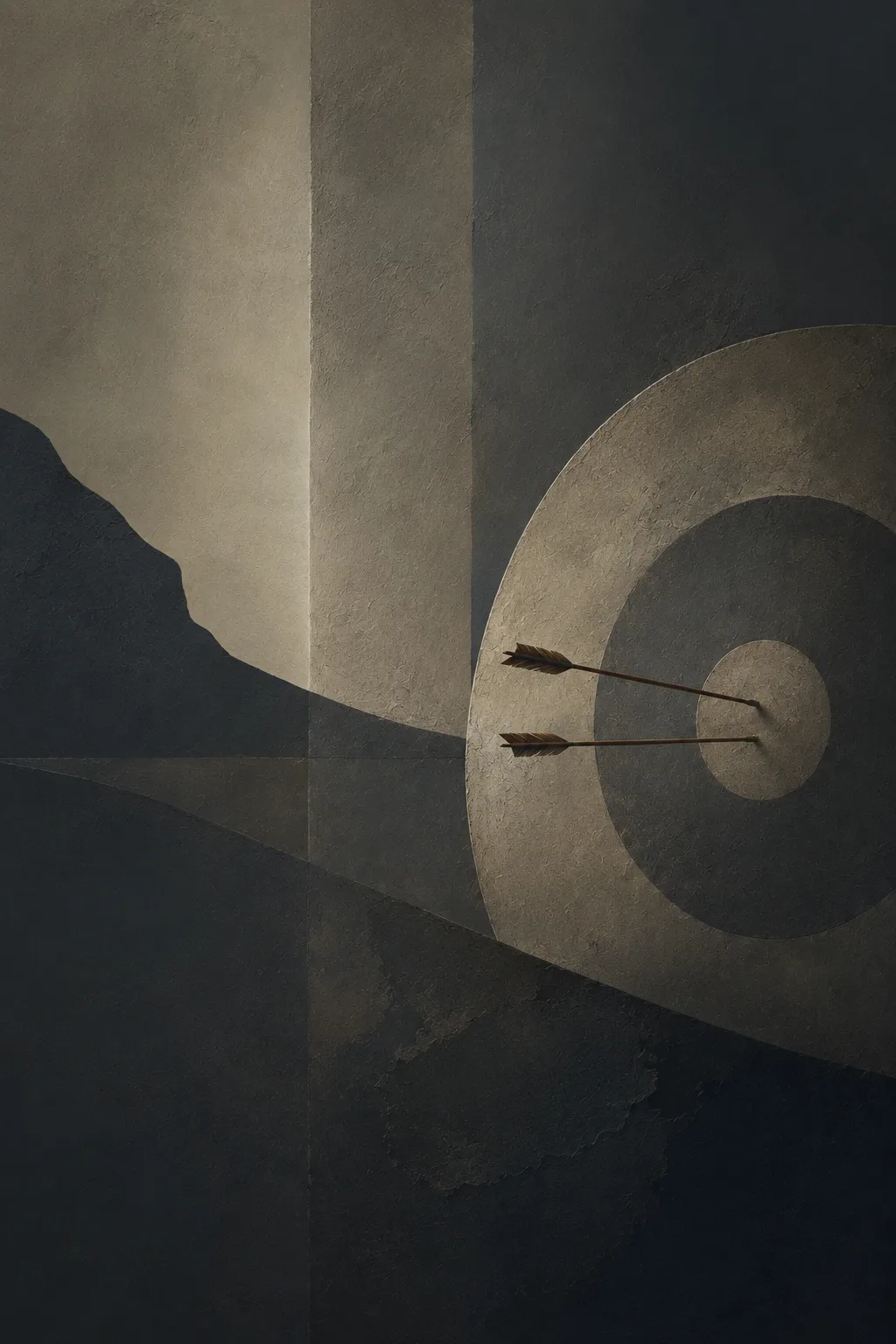
Growth Is Using Yourself Wisely
It's tempting to think of growth as learning more and acquiring more ability.
But what matters in life isn't how much you know — it's how you put what you know to use in reality.
You can know what's right and still make the same choice again. You can understand how you should act and still react the old way when the moment actually arrives.
Knowledge alone doesn't change a life.
If knowledge is understanding a principle or a method, wisdom is the ability to apply that understanding to the reality in front of you.
Think of archery. Knowledge is knowing the mechanics of drawing a bow. Wisdom is reading the distance, the wind, and your own state, and actually hitting the target.
The mechanics stay the same, but the conditions never do.
The wind shifts direction. The distance to the target changes. Even the archer's own breath and grip strength vary from shot to shot.
So hitting the target takes more than repeating a method you once learned.
It takes noticing what's different right now, and adjusting your force and aim accordingly.
Life works the same way.
As time passes, your surroundings and relationships change. So do the roles you carry and the responsibilities that come with them. A way of protecting yourself that worked yesterday can hold you back today, and a choice that once served you well may no longer fit.
Living wisely doesn't mean applying the same answer to every situation.
It means noticing what has changed and adjusting your attitude and approach to meet it.
But change doesn't mean everything about you needs to change.
Some parts of us shift with time. Others surface again and again, across very different situations.
Emotions, thoughts, desires, and goals can all change. What tends to last longer is the way you instinctively react, the role you keep taking on in relationships, and the values and direction you find hard to give up.
Wisdom begins by telling these two apart.
It means noticing what has shifted because of the current situation, and what has carried through as your own long-standing pattern.
Treat everything as fixed nature, and you stay trapped in who you used to be. Believe everything can be changed, and you lose your center.
Knowing yourself isn't defining yourself as one personality or a handful of traits.
It's holding what changes and what repeats in view at the same time.
It's learning which situations shake you, which choices trigger the same reaction every time, what makes you feel most like yourself, and what pulls you away from your own center.
The more this understanding builds, the more wisely you can use yourself.
Growth doesn't mean becoming an entirely different person.
It means looking closely at yourself, learning what changes and what endures, and learning how to use yourself well in whatever life you're living right now.
If the wind has shifted, adjust the angle of the bow.
But never lose sight of what you're actually aiming at.
Growth isn't charging forward without a plan. It's choosing your life a little more wisely, without losing your center, even as time keeps changing around you.
So what do you need right now — more knowledge?
Or the wisdom to use what you already know, differently?